Results of a Customer Survey on Pelvic Pain Syndrome (Chronic Pelvic Pain Syndrome)
In a survey conducted by QRS International among its Pelvicenter customers in 2021, treatment experiences and outcomes relating to Pelvic Pain Syndrome (PPS), also known as Chronic Pelvic Pain Syndrome (CPPS), were collected and evaluated. The results are shown below.
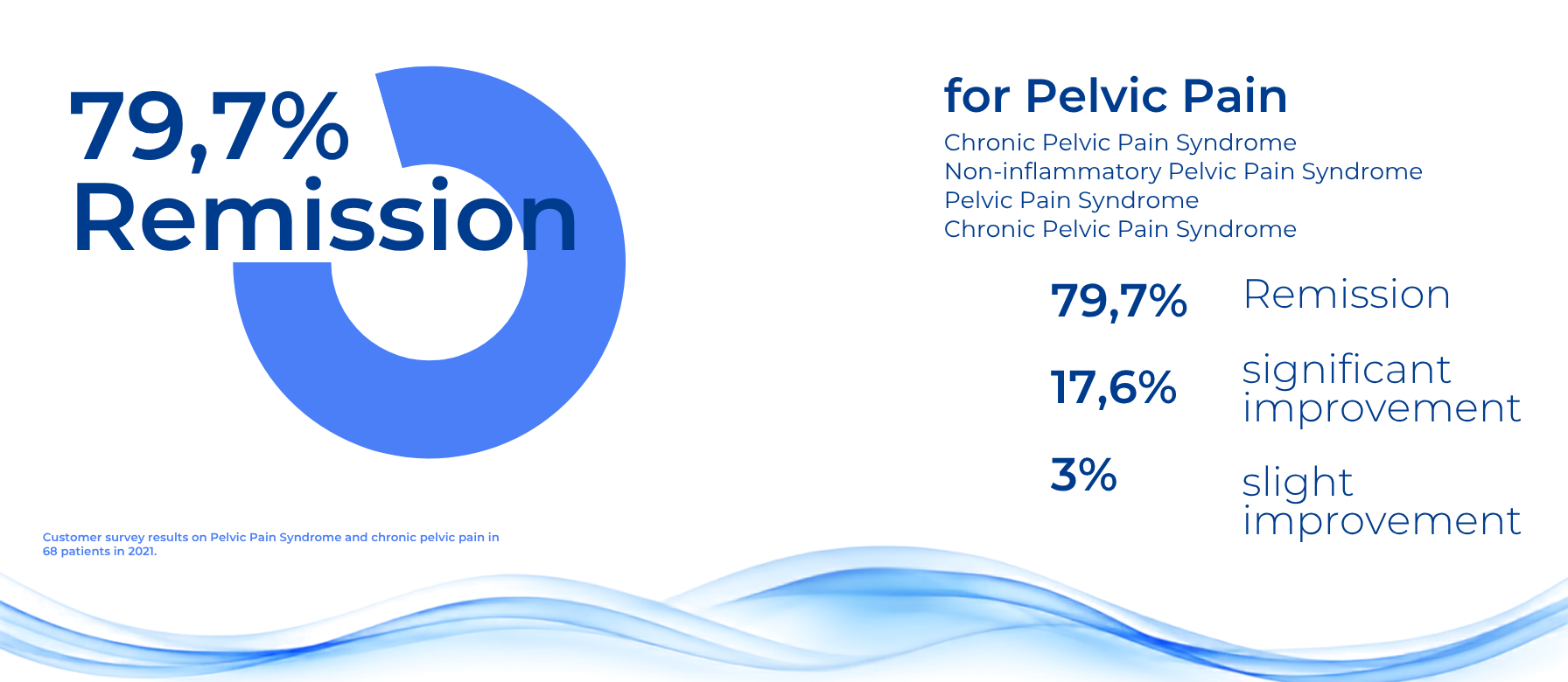
According to feedback received from QRS Pelvicenter operators, 68 patients with Pelvic Pain Syndrome were treated with magnetic stimulation using the QRS Pelvicenter during 2021. The survey population consisted of 46 women and 22 men, with an age range of 21 to 62 years.
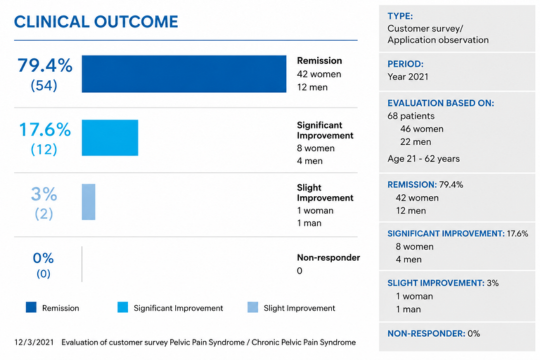
The results: 79.4% (54) of patients achieved remission. In 17.6% (12) a significant reduction in pain occurred, and in 3% (2) only minor improvements were achieved. It is pleasing that there were no non-responders.
- 79.4% (54 patients) became completely symptom-free
- 42 women, 12 men
- 17.6% (12 patients) experienced significant improvement
- 8 women, 4 men
- 3.0% (2 patients) experienced only minor improvement
- 1 woman, 1 man
- 0% non-responders
A notable observation was that many patients who ultimately recovered experienced rapid improvements after only a few treatment sessions. Several patients reported noticeable positive changes after just two or three treatment session.
Several female patients initially reported pain during sexual intercourse. A 21-year-old patient reported complete resolution of symptoms after five treatment sessions. A 51-year-old patient became symptom-free after four treatment sessions.
The survey also found that patients generally continued to experience either no pelvic pain or only occasional symptoms months after completing therapy. A common response among participants was that they would be willing to repeat the treatment if necessary.
How Is This Therapeutic Success Explained?
According to QRS, Pelvic Pain Syndrome is frequently associated with a myofascial syndrome, involving muscular tension and dysfunction within the pelvic floor region. The proposed therapeutic approach aims to significantly increase microcirculation in the pelvic floor and produce a large number of muscle contractions and relaxations. The repeated contraction-relaxation cycles make it difficult for muscular tightness to persist.
Summary
According to the survey evaluation, 5 to 10 treatment sessions, each lasting 15 to 20 minutes, were often sufficient to substantially reduce non-inflammatory pelvic pain. The probability of complete pain relief through magnetic stimulation with the QRS Pelvicenter very high 80%. In approximately 18% of cases, at least a noticeable degree of pain reduction was achieved; approximately 2–3% of patients experienced only minor improvement, and no patients were classified as non-responders.
Based on these survey results, QRS concludes that magnetic stimulation using the QRS Pelvicenter may be considered a highly effective treatment option for Pelvic Pain Syndrome.