Studies of magnetic stimulation for stress incontinence put to the test
Evidence-Based QRS Technology Meets the Highest Level of Clinical Research
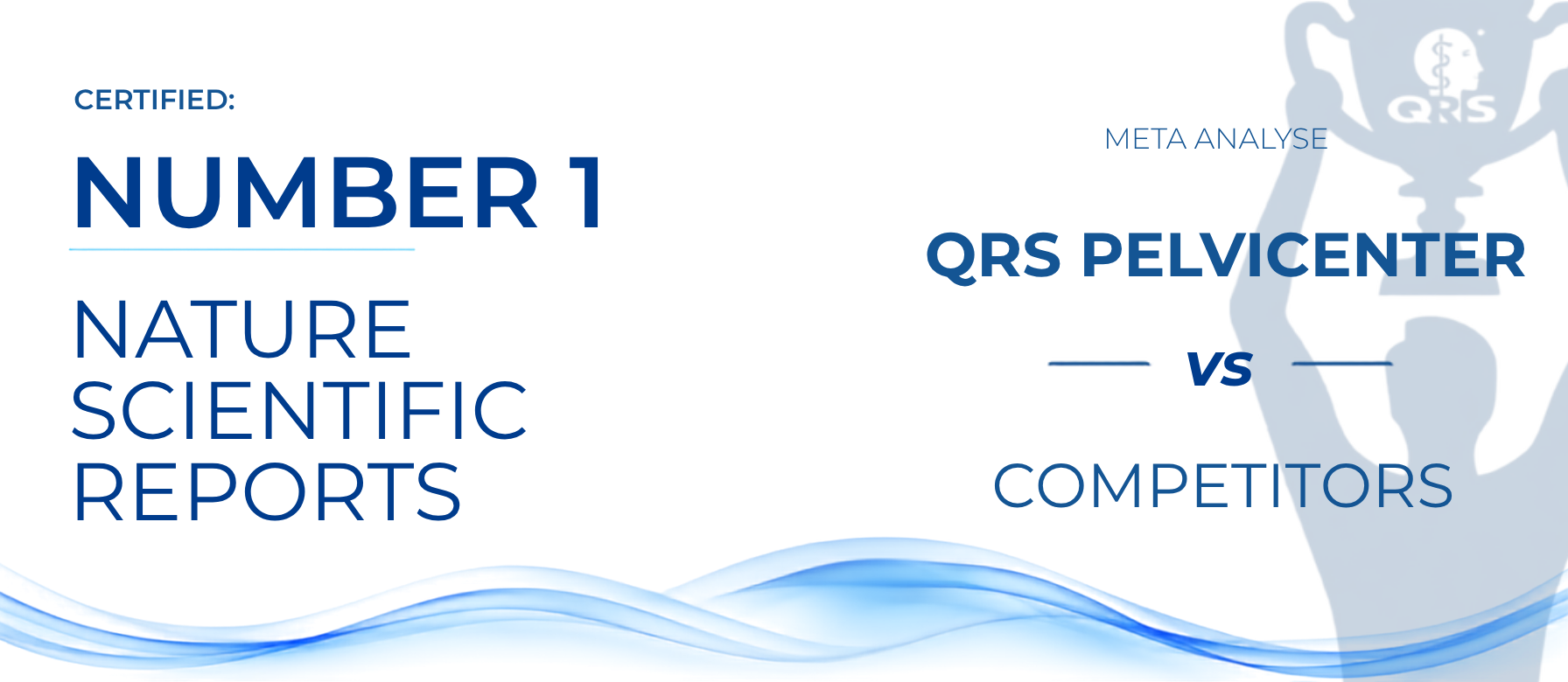
The scientific journal “Scientific Reports”, which belongs to the “Nature Portfolio”, conducted a meta-analysis on the topic of “magnetic stimulation of stress incontinence” in 2018 and published it in June 2019.
The scientific journal “Nature” is among the world’s most influential publications in natural sciences. Its Journal Impact Factor (JIF) is 48.5 (as of 2024). This is a high value in scientific disciplines and indicates that the published works are widely received internationally and frequently referenced in research. The journal “Scientific Reports“ and the studies published therein also show a high reputation and credibility. These publications are cited and referenced by researchers worldwide and used in further scientific work.
Research objective
The Scientific Reports meta-analysis on “magnetic stimulation of stress incontinence” was primarily intended to examine the reliability of international studies on this topic. Relevant literature databases, including EMBASE, PubMed, and the Cochrane Library, were consulted according to the Preferred Reporting Items for Systematic Reviews and Meta-Analyses (PRISMA) checklist.
The availability of randomized controlled trials (RCTs) was checked across all relevant manufacturers and market players of corresponding stimulation systems. Players who did not submit any relevant studies were not considered.
Scientific studies are inherently subject to potential risks of bias. These can occur even with a carefully designed study and influence or distort the reported results. Such biases often manifest as a systematic overestimation of positive effects. Therefore, this meta-analysis paid particular attention to potential risks of bias, and the available evidence-based studies were systematically analyzed for possible bias effects.
The potentially relevant studies were reviewed independently by two authors. Two additional reviewers independently assessed the quality of all selected studies. The methodological quality of all randomized controlled trials (RCTs) was assessed using the Jadad score and the Cochrane Risk of Bias tool.
The meta-analysis was performed using RevMan software version 5.3 (Cochrane Collaboration, Oxford, UK). The efficacy of magnetic stimulation treatment was assessed by calculating the odds ratio (OR), mean difference (MD), and standardized mean difference (SMD), including the corresponding 95% confidence intervals (CI), for the comparison between active and sham stimulation.
Examination result
Of all randomized controlled trials, only one met all the conditions necessary to rule out any potential bias in the study results. This study is the randomized, placebo-controlled clinical trial by Lim R et al. (2017) of the QRS 1010 Pelvicenter system (developer/patent: Prof. Dr. Fischer AG/WO 2011/045002 A1).
It is particularly emphasized that this study achieved the highest possible Jadad score. The Jadad score, also known as the Oxford scale, is a quality assessment scheme used to evaluate the correct conduct of a study with regard to randomization, blinding (placebo control), and dropouts.
In the aforementioned study with 120 female participants, 16 treatment sessions, each with a 15-minute stimulation duration, were sufficient to bring approximately 75% (vs. 21.7% placebo) of the patients into remission, or for 41.7% to be assessed as “completely continent” again. The remission rate remained at 72.2% even after one year, demonstrating the high sustainability of stress incontinence stimulation with the QRS 1010 Pelvicenter. The QRS Pelvicenter study was published in “The Journal of Urology,” the most widely read and frequently cited medical journal in the field of urology, covering the entire spectrum of urology and serving as the official publication of the American Urological Association (AUA).
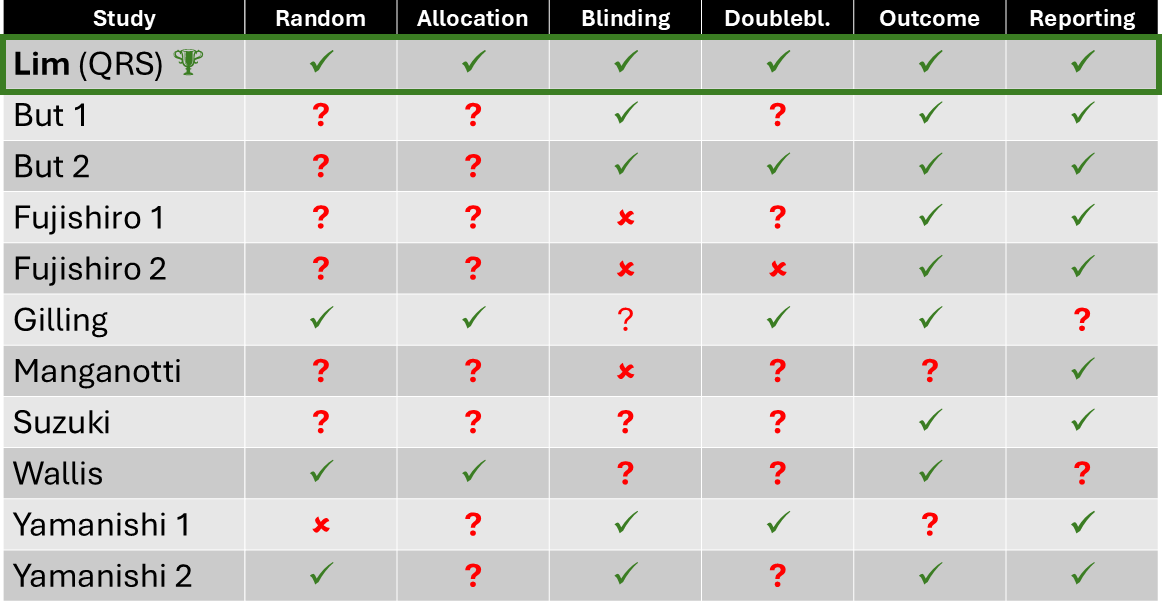
The table shows the parameters of the meta-analysis. The green checkmarks indicate which study is considered to have the highest level of confidence.
Summary
The meta-analysis published in the journal ” Scientific Reports” shows that the international body of research on magnetic stimulation for stress incontinence must be carefully evaluated, because potential risks of bias play a crucial role. Of the randomized controlled trials analyzed, only one fully met the methodological requirements for high-quality, bias-free study design.
This refers to the independent, randomized, placebo-controlled clinical trial by Lim R. et al. (2017) on the QRS 1010 Pelvicenter magnetic stimulation system, which achieved the highest possible Jadad score and thus demonstrates particularly high methodological quality. The results show a significant clinical improvement in patients with stress incontinence, with a remission rate of approximately 75% compared to 21.7% with placebo, and a sustained effect for up to one year.
Based on this scientific evaluation, the QRS 1010 Pelvicenter represents a reliable, evidence-based system for magnetic stimulation in the treatment of stress incontinence, the efficacy of which has been demonstrated in a methodologically rigorous study. The results underscore the potential of the QRS system as an effective and sustainable therapeutic option in the treatment of stress incontinence.
Sources
Lim R, Liong ML, Leong WS et al. Pulsed magnetic stimulation for stress urinary incontinence: 1-year follow-up results. J Urol. 1017; 197(5): 1302-1308
Pulsed Magnetic Stimulation for Stress Urinary Incontinence: 1-Year Followup Results | Journal of Urology
He Q, Xiao K, Peng L et al. An effective meta-analysis of magnetic stimulation therapy for urinary incontinence. SciReports. 2019) 9:9077 2019) 9:9077
An Effective Meta-analysis of Magnetic Stimulation Therapy for Urinary Incontinence | Scientific Reports