Pelvic Floor Prophylaxis
© Springer-Verlag GmbH Austria, part of Springer Nature 2020
Vivea Health Hotels, Vivea Science, Bad Vöslau, Austria | Atlantic International University, Honolulu, USA | Dr. Krapf Medical R&D, Munich, Germany
ISSN: 1023-6090 | DOI: 10.1007/s41972-020-00127-1
Journal of Urology and Urogynecology (Austria)
Journal for Urology and Urogynecology in Clinical Practice
The journal serves as a practice-oriented continuing education publication aimed at providing current knowledge and developments in this field. Renowned experts contribute articles that address key topics encountered in daily clinical practice, helping healthcare professionals integrate the latest findings into routine patient care.
This informative and professionally written article provides a qualified discussion of pelvic floor dysfunction and explains the importance of a strong pelvic floor for overall physical integrity. It also examines the therapeutic use of rPMS technology with the QRS Pelvicenter.
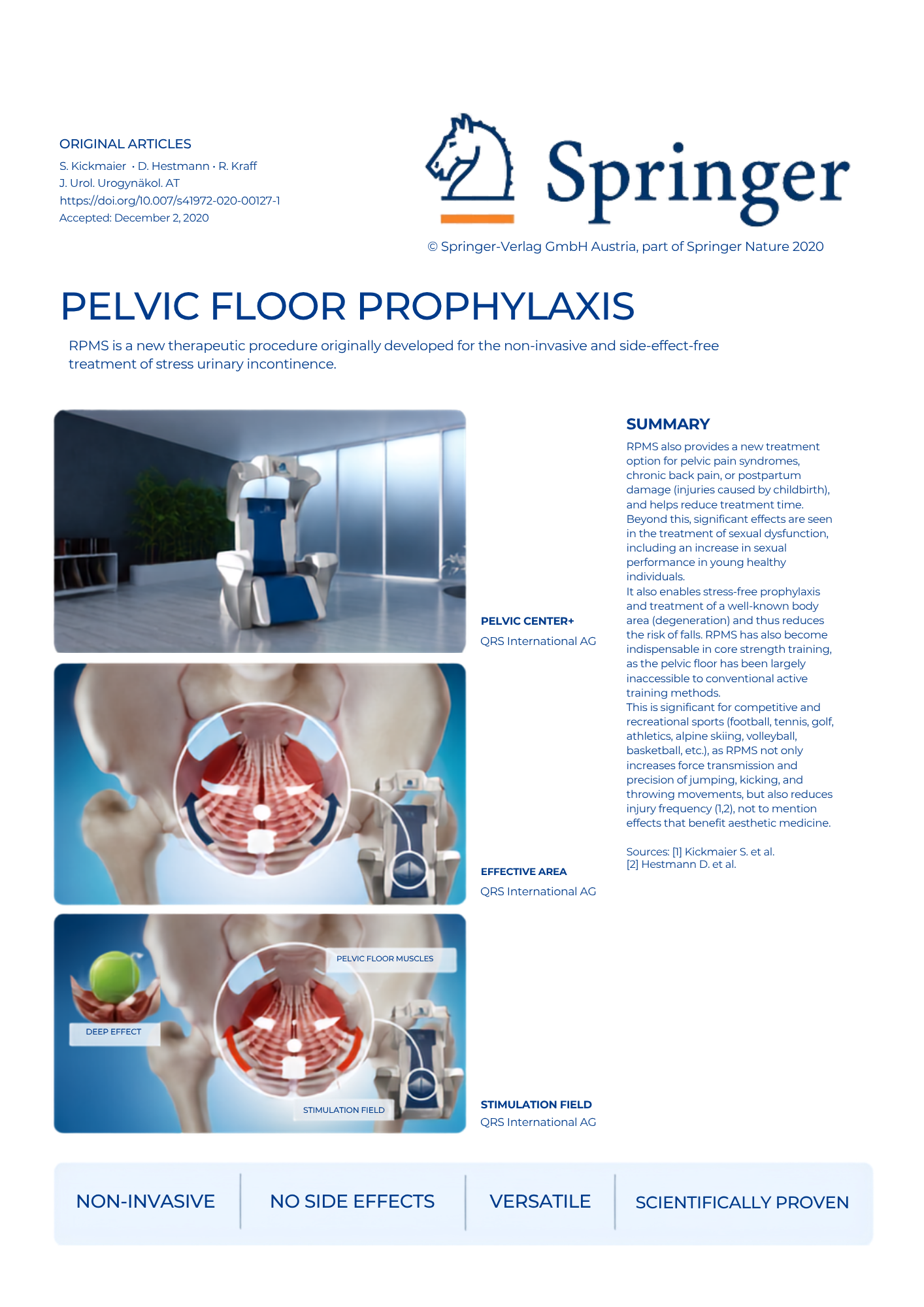
Summary illustration of the Springer article on the QRS Pelvicenter
Article on Pelvic Floor Prevention and Therapy
The authors describe the fundamental relationship between pelvic floor function and human physical integrity. They discuss both preventive pelvic floor care and therapeutic treatment options using the QRS Pelvicenter.
Excerpt from the Original Article
“It has always been a medical dream to imitate or directly influence the body’s own signaling to the muscles. This would make it possible to train deeper muscle layers and, consequently, the entire musculoskeletal system, providing access to preventive and therapeutic treatment without pain.”
“From this concept emerged a medical procedure that, due to its very high intensity requirements — up to 2 Tesla (unit of magnetic field strength) — closely resembles MRI technology and, as rPMS (repetitive peripheral magnetic stimulation), can significantly expand preventive and therapeutic possibilities in neurology, orthopedics, sports medicine, urology, and even sexual medicine.”
Authors’ Original Summary
rPMS is a relatively new therapeutic method originally developed for the non-invasive and side-effect-free treatment of stress urinary incontinence. Since introduction, it has also evolved into a treatment option for pelvic pain syndromes, chronic lower back pain, childbirth-related injuries, and the prevention of childbirth-related pelvic floor damage. In addition, observable effects have been reported in the treatment of sexual dysfunction, including improvements in sexual performance among healthy young adults.
The therapy also enables low-impact prevention and treatment of age-related muscle loss (sarcopenia), thereby helping reduce the risk of falls. rPMS has also become increasingly relevant in core-strength training because the pelvic floor muscles are difficult to access through conventional exercise methods. According to the authors, this has significant implications for both recreational and professional sports, including football, tennis, golf, track and field, alpine skiing, volleyball, and basketball. The article suggests that rPMS may contribute to improved force transmission, greater movement precision during jumping, kicking, and throwing activities, and reduced susceptibility to extremity injuries. The authors also note potential applications in aesthetic medicine.
Related Publications
 Springer-Verlag Austria Article – Pelvic Floor Prophylaxis
SpringerLink article summary:
SpringerLink Database – Pelvic Floor Prophylaxis with QRS Pelvicenter rPMS
Additional SpringerLink publications related to the QRS Pelvicenter:
Magnetic Stimulation for Stress Urinary Incontinence: Study Protocol for a Randomized Controlled Trial
Effect of Pulsed Magnetic Stimulation on Quality of Life of Female Patients with Stress Urinary Incontinence: An IDEAL-D Stage 2b Study
Patients’ Perception and Satisfaction with Pulsed Magnetic Stimulation for Treatment of Female Stress Urinary Incontinence
Further information about the QRS Pelvicenter:
QRS Pelvicenter Magnetic Stimulation Pelvic Floor Therapy
Magnetic Stimulation for Bladder Weakness and Urinary Incontinence